

Table of Contents
Walk into most Austin offices and the first thing a visitor notices isn’t the furniture. It’s the signage. Good office signage in Austin tells someone exactly where to go and who you are. In fact, it communicates what your brand stands for before anyone says a word. Bad office signage does the opposite. For example, it sends candidates wandering down the wrong hallway and makes a $40 million lease look like a garage sale.
This guide covers everything you need to know about office signage Austin businesses actually invest in. That includes reception signs, wayfinding, conference room plaques, branded wall graphics, ADA room-ID requirements, and realistic 2026 pricing. Whether you’re outfitting a single-tenant HQ in the Domain or a law firm suite downtown, the same principles apply.
What Office & Corporate Signage Actually Covers
“Office signage” gets used loosely, so let’s define it clearly. Exterior building identification — monument signs, channel letters, and building-top logos — falls under a separate category entirely. This post focuses on what happens once someone walks through your front door.
Interior Signage Is Its Own Category
Interior office signage includes everything a visitor or employee sees inside the building envelope. Specifically, that means reception and lobby signs, directional and wayfinding signage, and conference room name plaques. It also covers suite and door ID signs, branded wall graphics, digital directories, and ADA-compliant room identification.
Additionally, interior signage has different rules than exterior. There’s no city sign permit for most of it. However, ADA compliance becomes far more strict indoors, especially around room identification. We’ll cover that in detail below.
Who Actually Needs This
Corporate headquarters, multi-tenant office towers, and coworking operators all need some version of interior signage. So do medical suites, law firms, financial services firms, and nonprofit offices. In fact, almost any business leasing commercial office space in Austin eventually runs into at least one of these signage decisions.
Every office signage Austin project we quote starts from that same short list of needs. From there, it scales up or down based on square footage, tenant count, and how many rooms actually require permanent identification.
Types of Office Signage Every Company Should Know
Interior office signage isn’t one product — it’s a system made up of several distinct sign types, each with a different job. Here’s the full breakdown.
Reception & Lobby Signs
Your lobby sign is the corporate equivalent of a firm handshake. It’s usually a dimensional logo — flat-cut acrylic letters or a lit channel letter set — mounted on a feature wall behind the reception desk. As a result, it’s almost always the most-photographed sign in the building. In fact, it shows up in every job listing photo and every LinkedIn post.
See our full breakdown of reception design options here: Office and lobby signs
Directional & Wayfinding Signs
Wayfinding signage guides visitors, vendors, and new hires through hallways, floors, and departments without needing a front-desk escort every time. Meanwhile, good wayfinding also reduces liability by keeping people away from restricted or mechanical areas.
Corporate campuses raise the stakes further. Near the Domain and along Southwest Austin’s office corridors, many companies occupy multiple buildings on one property. In those cases, wayfinding has to work at the campus level, not just inside one lobby. That means directional signage in parking structures and between-building path signs. It also means monument-style directories that point visitors toward the correct building before they ever reach a front door.
For a deeper dive into wayfinding systems, safety signage, and code requirements, see: Wayfinding and safety signs
Conference Room Name Plaques
Conference room signs typically combine a room name (often themed — Texas rivers, local landmarks, or numbers) with a digital or manual “in use” indicator. Some companies add e-paper displays that sync to the calendar system automatically. Others keep it simple with a slide-in paper insert behind acrylic.
Door & Suite ID Signs
Suite numbers, department labels, and individual office nameplates all fall into this category. These signs need to match ADA room-identification rules whenever they label a permanent room, which we’ll unpack shortly.
Branded Wall Graphics
Corporate wall graphics turn blank hallways and breakrooms into brand statements. Common formats include vinyl wall decals, dimensional letters spelling out company values, printed wallcoverings, and frosted window film with a logo pattern. Consequently, these graphics do double duty — they reinforce culture for employees and impress visiting clients at the same time.
Digital Directories & ADA Room Signage
Multi-tenant buildings often need a lobby directory listing every tenant by floor or suite. Digital directory screens have largely replaced the old backlit letter-board directories. Tenant changes happen constantly, and nobody wants to reorder plastic letters every time a company moves out. ADA room signage rounds out the list — tactile, Braille-inclusive plaques for restrooms, exits, and permanent rooms. It’s legally required in far more places than most facility managers realize.
Office Signage by Building Type
Austin’s office market isn’t uniform, and neither is the signage that fits it. Office signage Austin companies choose depends heavily on building type, submarket, and how many other tenants share the address.
Single-Tenant Headquarters
A company that occupies an entire building has the most signage freedom. This is common for growing tech firms near the Domain or in Southwest Austin’s office parks. There’s no landlord signage committee to satisfy. As a result, branding can extend from the parking lot straight through the lobby, hallways, and every conference room.
Multi-Tenant Office Buildings
Downtown high-rises and Class A towers along MoPac usually have strict landlord sign criteria. For example, suite ID signs often must match a building-standard size and mounting height. That keeps every tenant’s signage looking consistent from the elevator lobby. Therefore, it’s worth reviewing your lease’s signage exhibit before ordering anything.
Coworking & Flexible Office Space
Coworking operators need signage that’s flexible by design. Think modular directories, changeable suite labels, and wayfinding that can be updated as members rotate in and out. Otherwise, the directory becomes outdated within a month.
Medical & Professional Office Suites
Medical offices, dental practices, and professional suites carry the heaviest ADA burden of any building type. Patients with disabilities interact directly with room signage on every visit. Meanwhile, law firms and financial services firms tend to invest in higher-end conference room and reception signage, since clients judge credibility fast.
See industry-specific signage guidance here: Professional office signs, Legal office signs, and Financial services signs
Design Considerations for Office Signage
Great office signage Austin design balances four things: brand, clarity, durability, and light. Miss any one of them and the whole system feels off.
Brand Consistency
Every sign in the building should use the same logo files and approved color values. It should also match the typography on your website and business cards. Otherwise, mismatched blues or slightly-off fonts quietly undercut the professionalism you’re trying to project.
Wayfinding Clarity for Visitors
Design signage for someone who has never been in your building before, not for employees who already know the floor plan. Consequently, use consistent icon systems, high-contrast text, and repeat directional cues at every decision point — elevators, hallway junctions, and stairwells.
Material Choices for Interior Durability
Acrylic, brushed metal laminate, and PVC substrate all perform well indoors. However, they age differently under office lighting and daily hand contact near doorways. As a result, high-touch signage like door plaques should use scratch-resistant materials. Meanwhile, lobby feature walls can use more delicate finishes, since nobody touches them.
Lighting
Backlit or halo-lit lobby signs create a premium look, but they need an electrician for power runs during buildout. Meanwhile, ambient lighting throughout hallways should hit signage evenly — a beautifully designed sign in a dark corner accomplishes nothing.
ADA Requirements for Interior Office Signage in Austin
This is the section most companies skip, and it’s the one that creates real legal exposure. Interior office signage falls under the 2010 ADA Standards for Accessible Design, and the rules are specific. Office signage Austin building owners install without checking these standards often ends up needing a costly retrofit later.
Room ID Signs Need Tactile & Braille Text
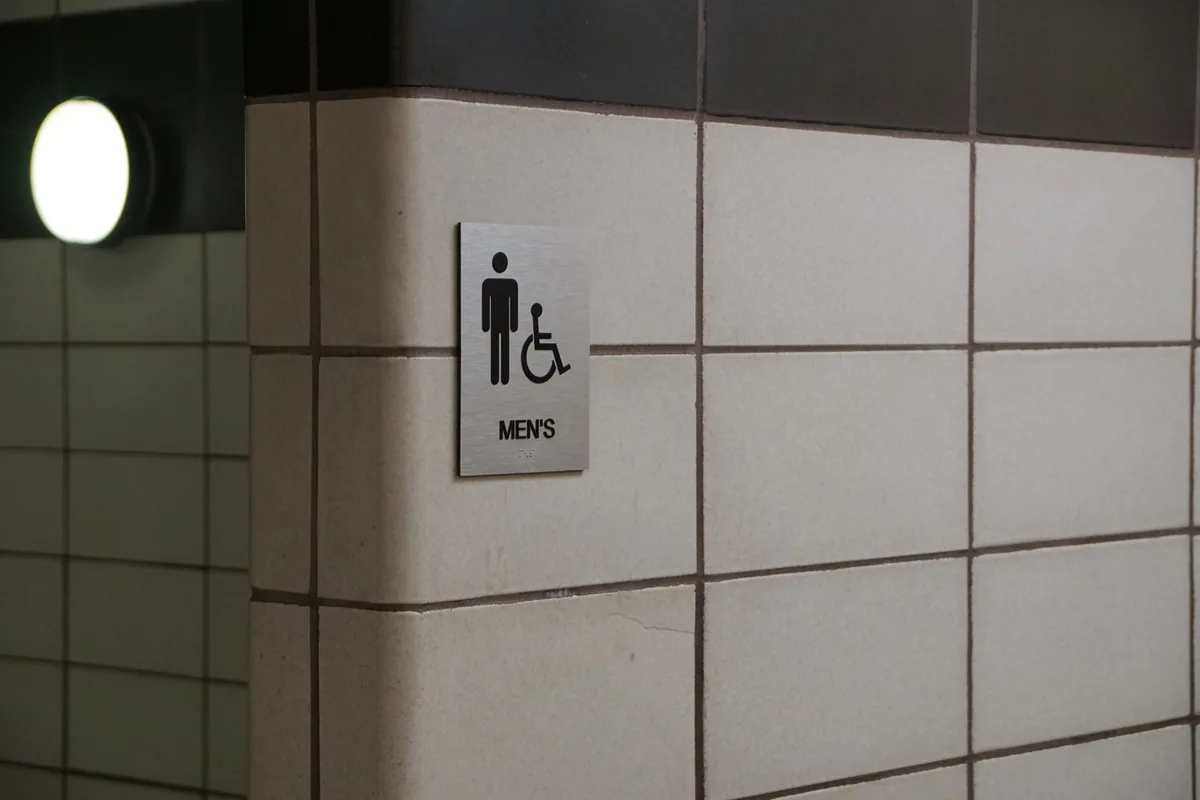
Any sign that identifies a permanent room must include raised tactile characters and Braille. This covers restrooms, conference rooms with fixed names, exits, and stairwells. However, temporary or changeable signage — like a directory listing that updates often — is generally exempt from the tactile requirement. The permanent room labels are not exempt.
Mounting Height & Location Rules Are Exact
The Access Board specifies mounting between 48 and 60 inches above the floor, measured to the baseline of the tactile characters. That sign must sit on the wall adjacent to the door, on the latch side. In addition, there must be clear floor space in front of the sign so a visitor using a wheelchair can approach and read it without obstruction. Character height, stroke width, and contrast ratios are all spelled out too. A sign shop familiar with these details saves a facilities team from guesswork.
Because these rules apply room by room, a single floor of private offices can easily need forty or fifty compliant plaques. Consequently, it pays to order them as one batch rather than piecemeal. Setup costs get spread across the whole run that way, instead of each individual sign.
For the full technical specifications, see the U.S. Access Board’s ADA accessibility guidelines: access-board.gov/ada and the Department of Justice’s 2010 ADA Standards: ada.gov/law-and-regs/design-standards/2010-stds.
Safety Signage Has Its Own Federal Rules
Fire exits, electrical rooms, and other safety-related interior signage also fall under OSHA’s accident prevention signage standard. For reference, see OSHA’s specification: osha.gov 1910.145.
Office Signage Austin Cost Guide (2026)
Pricing varies by sign type, materials, and quantity, but here are realistic 2026 ballparks based on what similar office signage Austin projects typically run.
- Lobby/reception sign: $500–$3,000+, depending on dimensional letters vs. a full backlit feature wall
- Individual room ID plaques (ADA-compliant): $40–$150 each, with pricing dropping per-unit on larger orders
- Conference room signage with digital “in use” displays: $150–$600 per room
- Door/suite ID signs: $60–$200 each
- Branded wall graphics: $300–$2,500+ per wall, depending on size and material
- Digital lobby directory: $1,500–$6,000+ for hardware, mounting, and software setup
- Full wayfinding system for one floor: $2,000–$8,000+, covering all directional signage, suite IDs, and ADA room signs
Naturally, a single-suite law office needs far less than a 40,000-square-foot HQ buildout. However, most mid-size Austin office projects land somewhere between $5,000 and $15,000. That’s typically for one floor of a multi-tenant building, once reception, wayfinding, and ADA room signage are all included.
Several factors push those numbers up or down. Rush timelines, for instance, usually add a percentage-based fee, since production gets bumped ahead of other jobs in the queue. Custom finishes cost more than standard acrylic but last considerably longer under daily wear — think real wood veneer, metal-look laminate, or backlighting. Meanwhile, ordering everything in one combined project almost always brings the per-sign price down, rather than adding signs piecemeal over several months.
The Office Signage Installation Process
A well-run signage project follows a predictable sequence. Here’s what it looks like from first call to final install.
Site Visit & Needs Assessment
First, we walk the space, measure wall dimensions, note lighting and power access, and confirm how many rooms and doors need signage. This step also uncovers landlord requirements in multi-tenant buildings before design work starts.
Design Proof & Approval
Next, we produce a design proof showing exact colors, materials, and placement. Most clients request one or two rounds of revisions before sign-off. Meanwhile, we flag any ADA compliance issues during this stage, not after production.
Permitting (When Needed)
Most interior signage doesn’t require a permit. However, electrical signage tied into building power may need one. The same goes for any exterior-facing work bundled into the same project — both can require a permit through the City of Austin. We handle that filing directly when it applies.
Production & Installation
Once approved, production typically takes one to three weeks, depending on materials and order size. Installation happens after hours whenever possible to avoid disrupting business operations. As a result, most office-wide projects wrap up in a single day or two.
Common Mistakes Companies Make With Office Signage
We see the same issues repeatedly across Austin office projects. Here are the ones worth avoiding.
- Inconsistent branding across floors: different fonts or colors between the lobby sign and the third-floor directory make the company look disorganized.
- Wayfinding that assumes local knowledge: signage built for employees, not first-time visitors, sends guests the wrong way constantly.
- Ignoring ADA room-ID requirements: skipping tactile and Braille signage on permanent rooms creates real compliance risk, not just an aesthetic gap.
- Choosing cheap materials that look dated fast: printed paper inserts and thin vinyl scratch and yellow within a year or two. That forces an early reorder anyway.
- Treating signage as an afterthought: ordering signage after move-in, instead of during buildout, often means retrofitting mounts and rushing timelines.
Office Signage Austin FAQ
How much does office signage cost in Austin?
Most mid-size office signage Austin projects run between $5,000 and $15,000 for a full floor, covering reception, wayfinding, suite IDs, and ADA room signage. Smaller single-suite projects can cost far less, while full-building buildouts can run considerably higher.
Is ADA-compliant signage legally required inside offices?
Yes. Any sign identifying a permanent room — restrooms, exits, and fixed-name conference rooms — needs tactile characters and Braille under the 2010 ADA Standards. This applies regardless of building size or tenant count.
How long does an office signage project take?
Production typically takes one to three weeks after design approval, and installation usually wraps up within a day or two. Larger multi-floor projects take longer, especially when landlord approval is involved.
Do I need a permit for interior office signage?
Usually not. Most interior signage skips the permitting process entirely. However, electrical signage tied into building power sometimes requires one. In that case, the permit goes through the City of Austin, and we handle the filing on the client’s behalf.
What’s the difference between office signage and corporate signage?
Honestly, the terms overlap heavily. “Corporate signage” often leans toward branding, such as wall graphics, logo walls, and culture-focused graphics. Meanwhile, “office signage” covers the full functional system, including wayfinding and ADA room IDs. Most projects need both.
Why Office Signage Matters (The ROI)
Signage feels like a small line item on a buildout budget, but the return shows up in ways that are easy to underestimate.
First impressions happen fast. A client walking into a polished, well-branded lobby forms an opinion before the first handshake. Similarly, job candidates notice. A confusing, unbranded office can quietly undercut recruiting efforts at exactly the moment a company is trying to look its best.
In addition, good wayfinding cuts down front-desk interruptions dramatically. Every visitor who has to ask “which way to Conference Room B?” pulls a receptionist away from other work. Multiply that by dozens of visits per week, and clear signage pays for itself in reclaimed staff time alone.
Finally, consistent branded signage reinforces culture for the people who see it every single day — your own employees. Office signage Austin companies invest in isn’t decoration. It’s infrastructure that works quietly in the background, every day, for years.
Get Started With Office Signage in Austin
Austin Sign Masters designs, fabricates, and installs complete office signage Austin businesses can count on. We work with headquarters, multi-tenant buildings, coworking spaces, and professional suites across the metro. From a single ADA room plaque to a full floor of wayfinding, we handle the site visit, design, permitting, and installation from start to finish.
Ready to fix your lobby, wayfinding, or conference room signage before it becomes a bigger problem? Reach out today for a free walkthrough and quote — we’ll tell you exactly what your space needs and what it will realistically cost.