
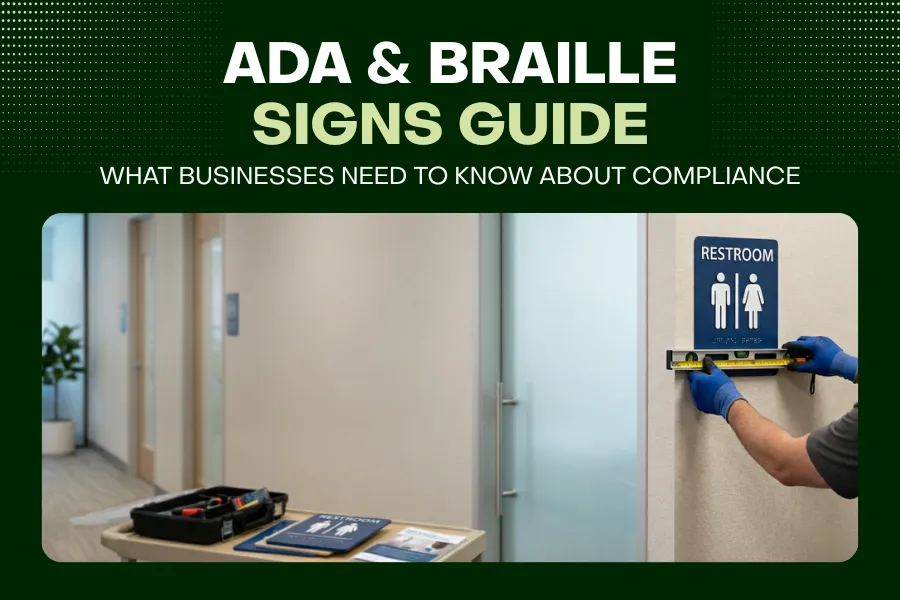
If you own or manage a business in Austin, accessibility is not optional. Federal and state regulations require many commercial spaces to install ADA compliant signage so people with visual impairments can safely navigate buildings.
One of the most important elements of accessible signage is Braille signs. Austin businesses must install to meet ADA requirements and ensure their facilities are accessible to everyone.
Many businesses only learn about ADA signage rules when opening a new location, remodeling a building, or preparing for inspections. Understanding these requirements ahead of time can prevent compliance issues and ensure your property remains accessible.
This guide explains what ADA signage is, where it is required, and how installing Braille signs Austin businesses rely on for accessibility helps protect both your customers and your business.
What Are ADA and Braille Signs
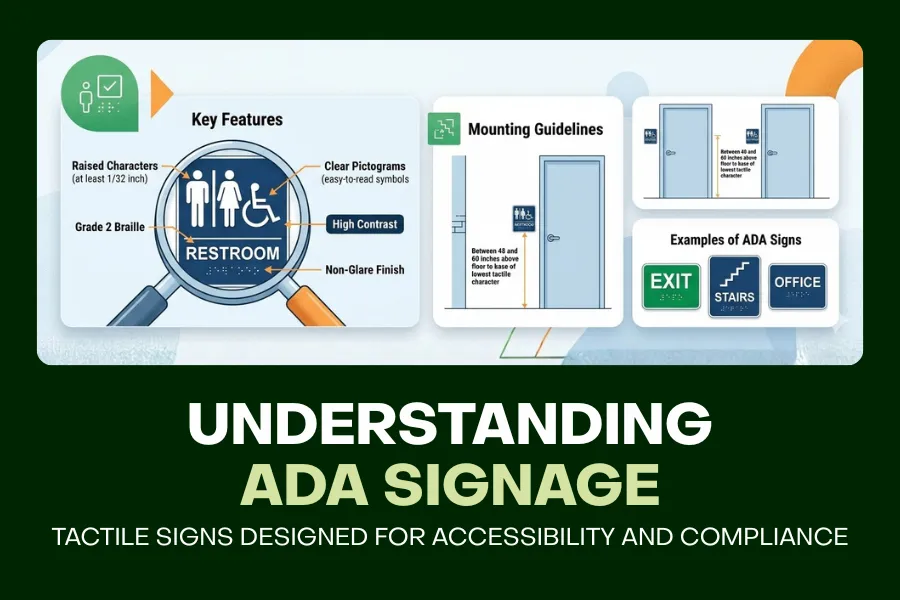
ADA signage refers to signs that comply with the Americans with Disabilities Act (ADA), a federal law designed to ensure accessibility for individuals with disabilities.
The ADA requires certain permanent room identification signs to include:
- Raised tactile characters
- Grade 2 Braille
- Proper mounting height
- High contrast colors
These rules allow people with visual impairments to read signage using touch.
The official ADA Standards for Accessible Design outline these requirements in detail and are maintained by the U.S. Department of Justice.
Businesses that install Braille signs Austin commercial buildings require ensure people with disabilities can independently navigate their spaces.
Why Braille Signs Are Important for Austin Businesses
Accessibility signage plays a major role in creating an inclusive environment.
Customers, employees, and visitors who are blind or visually impaired rely on tactile signage to locate important spaces such as restrooms, stairways, and offices.
Installing Braille signs Austin businesses use for ADA compliance provides several benefits:
- Ensures accessibility for everyone
- Helps businesses comply with federal ADA laws
- Reduces risk of compliance violations
- Creates a more welcoming environment for customers
The U.S. Access Board, which develops accessibility guidelines for buildings, explains how tactile signage improves building navigation for individuals with vision impairments.
For many businesses, installing Braille signs Austin properties require is both a legal requirement and an important step toward inclusive design.
Where ADA Braille Signs Are Required
Not every sign inside a building requires Braille. However, ADA guidelines specifically require tactile signage for permanent room identification and critical navigation points within a facility. These signs help individuals with visual impairments move independently and safely throughout a space without relying on assistance.
Understanding where these signs are required is essential for maintaining compliance and ensuring a consistent, user-friendly environment. Missing signage in key areas can lead to confusion, accessibility issues, and potential compliance violations.
Common areas where Braille signs Austin commercial buildings need include:
Restrooms
Restroom identification signs are one of the most recognized ADA requirements. These signs must include raised characters and Grade 2 Braille so visually impaired individuals can clearly identify the correct facility.
They should be placed on the wall adjacent to the door, typically on the latch side, rather than directly on the door itself. This ensures that the sign can be located easily by touch without obstruction.
Proper restroom signage is critical for both compliance and user comfort, as it provides clear and immediate identification in high-traffic areas.
Office and Room Identification
Any permanent room within a building must include ADA-compliant tactile signage. This includes offices, conference rooms, classrooms, storage rooms, and other fixed-use spaces.
These signs allow individuals to navigate independently by identifying specific rooms without needing assistance. Consistency in placement and design across all rooms is important to avoid confusion and create a predictable navigation experience.
For larger facilities, well-planned room identification signage plays a key role in overall wayfinding and accessibility.
Stairways and Exits
Stairways and exit routes are critical safety areas where accessible signage is often required. Tactile signs help individuals locate exits quickly, especially during emergencies when visibility may be reduced.
In multi-level buildings, stairwell signage may also include floor level indicators and directional information to guide occupants safely.
Ensuring proper signage in these areas supports both ADA compliance and overall building safety standards.
Elevators
Elevators are another important area where Braille signage is commonly required. Identification signs placed near elevator entrances help users locate them easily, while tactile markings on control panels allow individuals to select floors independently.
These features are especially important in commercial buildings, offices, hotels, and healthcare facilities where elevators are frequently used.
Proper elevator signage ensures accessibility across multiple levels and enhances the usability of the entire building.
These requirements make Braille signs Austin commercial properties install an essential part of building accessibility. By ensuring that all required areas are properly marked with compliant signage, businesses can create a space that is safe, inclusive, and easy to navigate for everyone.
ADA Design Requirements for Braille Signs
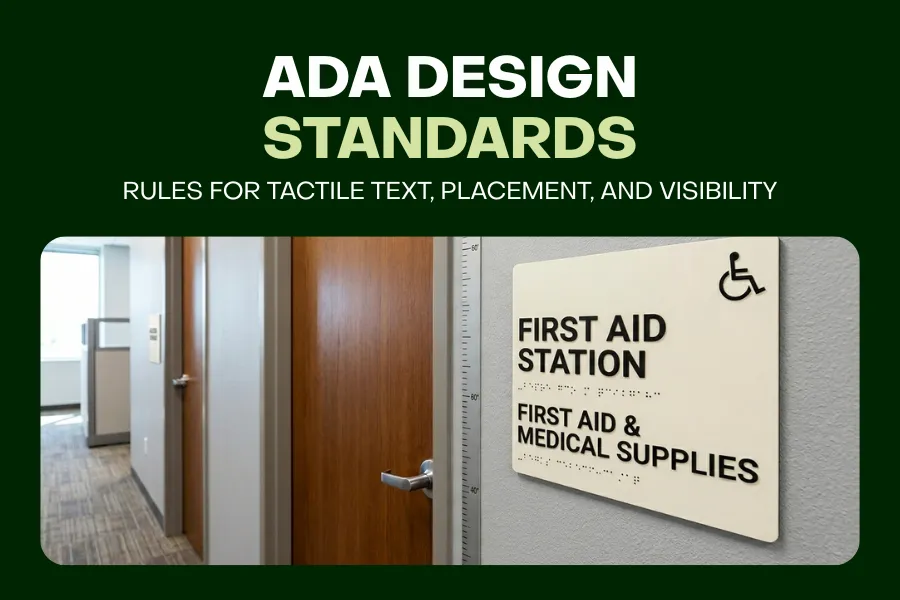
ADA signage is not just about including Braille. To be fully compliant, signs must follow strict design, spacing, and placement guidelines defined under the Americans with Disabilities Act. These standards ensure that signage is readable by touch, visually clear, and consistently placed so users can easily locate and understand it.
Failing to meet even one of these requirements can result in non-compliant signage, which may lead to failed inspections or accessibility issues within your space.
Raised Characters
Permanent room identification signs must include raised tactile characters that can be read by touch. These characters are typically required to be uppercase, non-decorative, and easy to distinguish with fingers.
The depth, spacing, and font style all play a role in readability. Overly stylized or script fonts are not allowed, as they can make tactile reading difficult. Characters must also be raised sufficiently from the surface to ensure they are easily detectable.
Properly designed tactile lettering ensures that individuals with visual impairments can accurately read and identify spaces within a building.
Grade 2 Braille
ADA standards require the use of Grade 2 Braille, which is a contracted form of Braille that uses abbreviations to improve reading speed and efficiency.
It is not enough to simply add Braille dots to a sign. The Braille must be accurately translated, properly spaced, and positioned directly below the corresponding text.
Incorrect translations, spacing errors, or using non-standard Braille formats can make the sign unusable for those who rely on it. This is why precision in fabrication and verification is critical when producing compliant signage.
Proper Mounting Height
Placement plays a crucial role in ADA compliance. Tactile signs must typically be installed so that the baseline of the lowest raised character is at least 48 inches above the finished floor, and the highest character does not exceed 60 inches.
This range ensures accessibility for individuals of varying heights, including those using wheelchairs.
In addition to height, signs must be positioned consistently, usually on the wall adjacent to the latch side of the door. Proper placement ensures that users can easily locate signage without confusion or obstruction.
High Contrast Colors
ADA signage must be visually readable in addition to being tactile. This requires strong contrast between the text and the background. For example, light text on a dark background or dark text on a light background improves visibility significantly.
Low-contrast combinations can make signage difficult to read, especially in dim lighting or for individuals with partial vision impairments.
Additionally, ADA guidelines require a non-glare finish to prevent reflections that could interfere with readability. Choosing the right materials and color combinations ensures that signage is both functional and compliant.
Texas businesses must also comply with the Texas Accessibility Standards (TAS), which reinforce and align with federal ADA requirements while adding additional clarity in certain areas.
Because these regulations involve precise measurements, formatting, and placement rules, many businesses choose to work with professionals to avoid errors. Proper planning and expert installation help ensure that Braille signs Austin buildings require meet both federal and state accessibility standards while maintaining a clean and professional appearance.
Common ADA Signage Mistakes Businesses Make
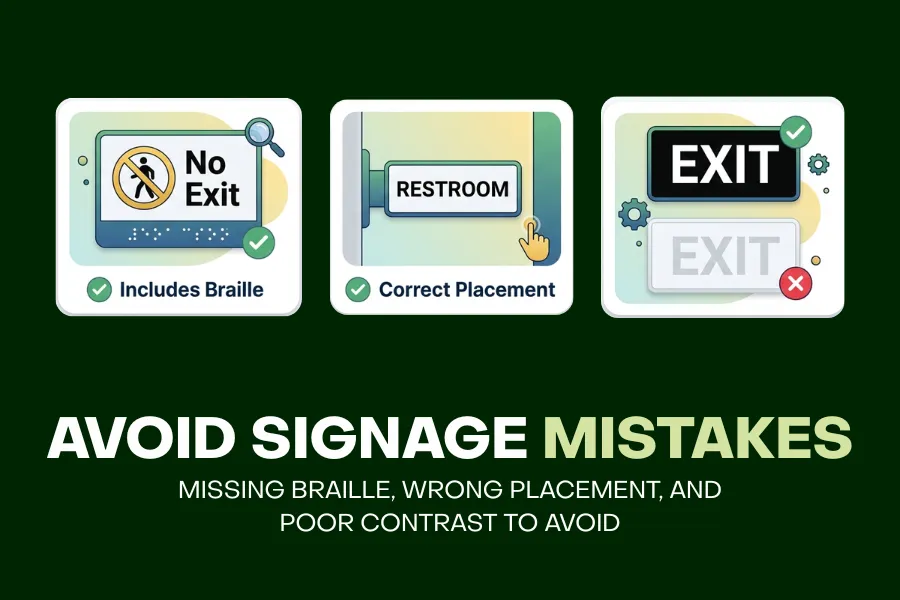
Many businesses unintentionally install signage that does not meet ADA requirements, especially when signage is handled without proper guidance or compliance knowledge. Even small mistakes in design, placement, or formatting can result in failed inspections, costly corrections, or accessibility issues for users.
Understanding these common errors can help ensure your signage is both compliant and effective from the start.
Missing Braille
One of the most common mistakes is installing signs that only include printed text without tactile lettering or Braille. While a sign may look visually correct, it does not meet ADA standards unless it includes raised characters and Grade 2 Braille.
Without proper tactile elements, visually impaired individuals cannot read or interpret the sign, which defeats the purpose of accessibility compliance. Every permanent room identification sign must include both raised text and Braille to meet ADA guidelines.
Incorrect Mounting Location
Proper placement is just as important as the design of the sign. ADA guidelines require that most tactile signs be installed on the wall adjacent to the latch side of the door, not directly on the door itself.
Placing signs incorrectly can make them difficult to locate, especially for individuals relying on touch. Inconsistent placement across a building can also create confusion and reduce usability.
Additionally, mounting height must fall within the ADA-specified range so that signs are accessible to all users, including those using wheelchairs.
Poor Contrast
ADA signage must be easy to read visually as well as through touch. One common issue is using low-contrast color combinations, such as light text on a light background or dark text on a dark surface.
Poor contrast reduces readability, especially in low lighting conditions or for individuals with partial vision impairments. ADA standards recommend high contrast between text and background along with a non-glare finish to improve visibility.
Choosing the right color combinations ensures that signage is clear, legible, and effective for all users.
Incorrect Braille Format
Not all Braille is ADA compliant. The ADA specifically requires Grade 2 Braille, which uses contractions to improve reading efficiency and standardization.
Using incorrect Braille formats, improper spacing, or inaccurate translations can make signs unusable for those who rely on them. Even minor errors in Braille can lead to confusion and misinterpretation.
This is why professional fabrication and verification are essential to ensure accuracy and compliance with established standards.
Avoiding these common mistakes ensures that the Braille signs Austin businesses install meet accessibility requirements, pass inspections smoothly, and provide a safe, inclusive experience for all visitors.
Texas Accessibility Standards and ADA Compliance
In addition to federal ADA laws, Texas businesses must follow the Texas Accessibility Standards (TAS).
These standards address details such as:
- Sign placement
- Braille positioning
- Tactile lettering
- Mounting height
More information can be found through the Texas Department of Licensing and Regulation.
Following these rules ensures Braille signs Austin commercial buildings require meet both federal and state accessibility laws.
Industries in Austin That Often Need Braille Signs
Many types of businesses must install ADA compliant signage.
Industries that commonly require Braille signs Austin facilities install include:
- Restaurants
- Retail stores
- Medical offices
- Office buildings
- Hotels
- Apartment complexes
- Schools and universities
- Government buildings
Any location open to the public must consider accessibility requirements when constructing or remodeling spaces.
Benefits of ADA and Braille Signage
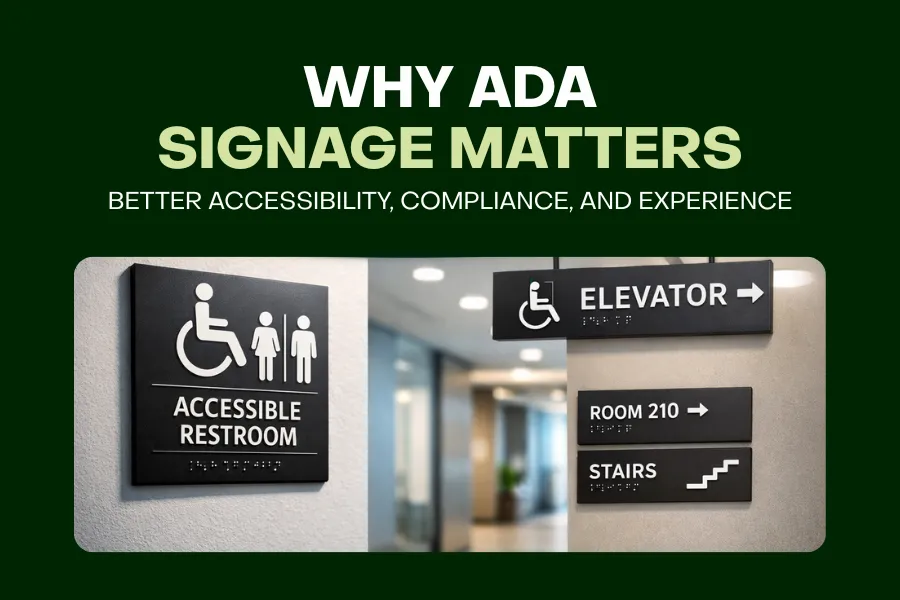
Installing proper ADA and Braille signage goes beyond simply meeting legal requirements. It plays a key role in improving accessibility, enhancing user experience, and strengthening the overall perception of your business.
When designed and installed correctly, ADA compliant signage becomes an essential part of how people interact with your space, ensuring it is functional, inclusive, and easy to navigate for everyone.
Accessibility for Customers
Accessible signage allows individuals who are blind or visually impaired to navigate a building independently and confidently. Raised characters and Braille provide a reliable way to identify rooms, restrooms, exits, and other important areas without needing assistance.
This level of independence is essential in creating an inclusive environment where all visitors, employees, and customers feel comfortable and supported. Proper ADA signage ensures that your space is usable by everyone, regardless of ability.
Compliance Protection
One of the most important benefits of ADA signage is ensuring your business meets federal and state accessibility regulations. Non-compliant signage can lead to failed inspections, legal issues, or costly modifications after installation.
By installing signage that meets ADA and Texas Accessibility Standards from the start, businesses can avoid unnecessary risks and ensure smooth approvals during inspections or audits.
Compliance not only protects your business legally but also demonstrates a commitment to accessibility and responsibility.
Better Customer Experience
Clear and well-placed signage improves navigation for all visitors, not just those with visual impairments. Customers can easily locate restrooms, offices, exits, and other key areas without confusion or delay.
This reduces frustration, saves time, and creates a smoother overall experience within your space. In busy environments such as offices, retail stores, or healthcare facilities, effective signage plays a major role in maintaining flow and organization.
Professional Appearance
High-quality ADA signage contributes to a clean, organized, and professional environment. Well-designed signs that match your interior branding create a cohesive look while still meeting compliance requirements.
Custom ADA signs allow businesses to maintain their brand identity while incorporating accessibility features, resulting in a space that feels both polished and functional.
A professional appearance not only enhances customer perception but also reinforces trust and credibility.
For many businesses, installing Braille signs Austin facilities require improves both accessibility and professionalism, creating a space that is compliant, welcoming, and thoughtfully designed for all users.
How Austin Sign Masters Can Help With ADA and Braille Signs
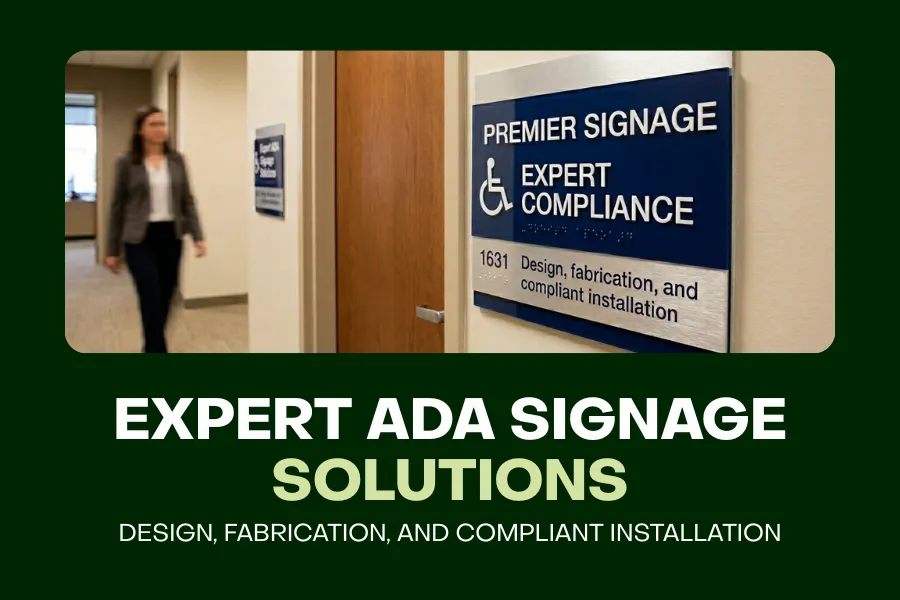
Understanding ADA regulations can be confusing for many business owners. From tactile lettering requirements to proper mounting height and placement, accessibility signage must follow strict standards.
At Austin Sign Masters we help businesses throughout Austin design, manufacture, and install compliant signage.
Our team can help you with:
- Custom ADA and Braille sign design
- Tactile lettering and Grade 2 Braille fabrication
- ADA compliant restroom and room identification signs
- Proper sign placement and installation
- Full compliance with ADA and Texas Accessibility Standards
ADA Compliance Done Right the First Time
ADA signage is not just about design, it is about precision and compliance.
Incorrect placement, improper Braille, or missing tactile elements can lead to failed inspections and costly corrections.
Working with experienced professionals ensures that your signage meets all required standards from the beginning, helping you avoid unnecessary risks, delays, and rework.
Get ADA Compliant Braille Signs Installed With Confidence
Ensuring your business meets ADA and Texas Accessibility Standards does not have to be complicated.
At Austin Sign Masters, we handle everything from design to installation, making sure your signage is fully compliant and professionally finished.
Whether you are opening a new location, remodeling your office, or updating outdated signage, we ensure your Braille signs Austin installation meets accessibility standards while maintaining a professional appearance.
If your business needs ADA compliant signage or accessibility updates, our team is ready to help create signage that keeps your business compliant and welcoming to everyone.
Contact our team today to request a consultation and ensure your business stays compliant and accessible here.