
Have you ever thought about just ordering a sign, installing it, and dealing with permits later?
Now imagine this: you spend thousands on a beautiful new sign, install it over a weekend, business is finally looking sharp… and then you get a notice from the City of Austin telling you the sign violates code, must be removed, and you may be subject to fines, enforcement action, or delays on future approvals.
That’s not a bad day. That’s a cash bonfire.
In this blog, we’re going to walk through what you need to know about sign regulations in Austin, why the City of Austin Land Development Code (LDC) is both a headache and a weapon, and why trying to DIY your way through sign permits is like doing your own dental surgery.
On the surface, Austin’s sign code looks like a pile of confusing rules and red tape. In reality, it can be the marketing moat that keeps your brand visible while competitors get stuck in violations, delays, and forced removals.
Spoiler: you shouldn’t. That’s what we’re here for.
Why Austin’s Sign Code Matters (And Why It’s So Painful)

Austin doesn’t treat signs as “just decoration.” The City has an entire chapter, Chapter 25-10, Sign Regulations in the Land Development Code, dedicated to how signs are defined, placed, lit, sized, and permitted.
A “sign” isn’t just a big panel with your logo on it. Under Austin’s and Texas definitions, a sign can be any identification, display, device, or graphic that directs attention to a product, business, service, or place, plus the supports, poles, and hardware that go with it.
Translation: If it shows your brand, message, logo, offer, or event, the City probably cares about it.
Why does the code exist?
- To control visual clutter
- To keep signs structurally safe
- To manage brightness and electronic displays
- To protect certain corridors, historic districts, neighborhoods, and scenic areas
That’s the city planning answer.
The marketing answer?
If you master this system and your competitors don’t… your fully compliant, high-impact sign stays up and dominates attention while they’re fighting corrections, denials, and removal notices.
That’s what we mean when we say the Austin sign code is your best marketing moat—not just a rulebook, but a framework you can use to stay visible while others struggle.
The Problem: You’re Not Supposed to Be a Code Nerd
You run a restaurant, bar, salon, gym, retail shop, medical office, or local brand in Austin and you still need professional, compliant company signs in Austin that actually get seen.
You shouldn’t have to:
- Decode Title 25, Chapter 25-10 of the Land Development Code
- Interpret setback rules, height limits, and sign area calculation
- Figure out if you’re in a special sign district, historic overlay, or scenic corridor
- Build scaled site plans, structural drawings, and attachment details that meet City standards
You’re supposed to focus on serving customers and growing your business.
Handled correctly, all that complexity becomes a barrier your competitors won’t cross—leaving you with a clear, long-term visibility advantage.
What Are Sign Regulations in Austin?
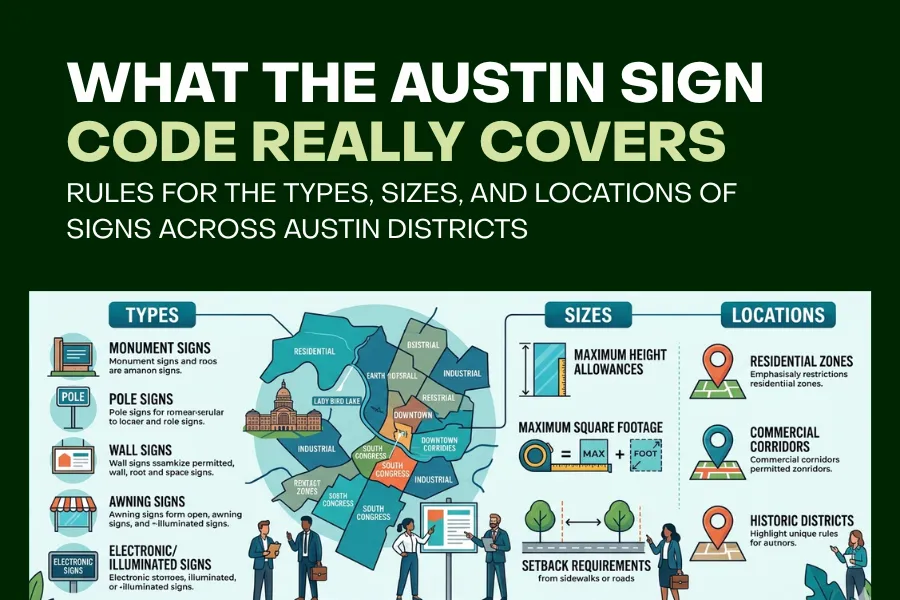
Short version: the City of Austin Sign Regulations (Chapter 25-10) tell you:
- What types of signs are allowed (on-premise, certain off-premise, temporary, etc.)
- How large they can be, how high they can be, and where they can go
- What’s allowed by-right vs. what needs extra review or a variance
- What you can do in different sign districts (neighborhood, scenic roadway, etc.)
- Rules for lighting, electronic displays, and illumination levels
All of this is wrapped in legal language, cross-references, and footnotes.
Yes, you could read it. No, you probably shouldn’t bet your business on “I skimmed some PDFs and it looks fine.”
What Are Commercial Sign Permits?
In Austin, a commercial sign permit is the City’s official approval that allows you to install, modify, or maintain your business signage in Austin. It’s how the City makes sure your sign is not just attractive, but also safe, legal, and appropriate for its surroundings. When you apply for a sign permit in Austin, you’re really getting reviewed for things like:
-
Size & placement
Making sure your sign isn’t blocking sightlines, sidewalks, or encroaching on someone else’s property.
-
Illumination levels
Controlling brightness so your sign is visible without creating glare or light pollution.
-
Safety & structure
Confirming the sign is engineered, mounted, and wired correctly so it can handle wind, weather, and electrical load.
-
Visual standards
Aligning your sign with corridor, neighborhood, or historic-district design rules.
In Austin, the types of signs that almost always require permits include:
- Monument signs
- Pylon / pole signs
- Channel letter building signs
- Digital / LED message displays
- Awning and canopy signs and other outdoor promotional signs in Austin that need to be both eye‑catching and fully compliant.
This is exactly the maze we navigate for you at Austin Sign Masters, so you don’t have to guess what needs a permit and what doesn’t.
How Do You Even Know What Rules Apply to Your Sign?
This is where most people get lost.
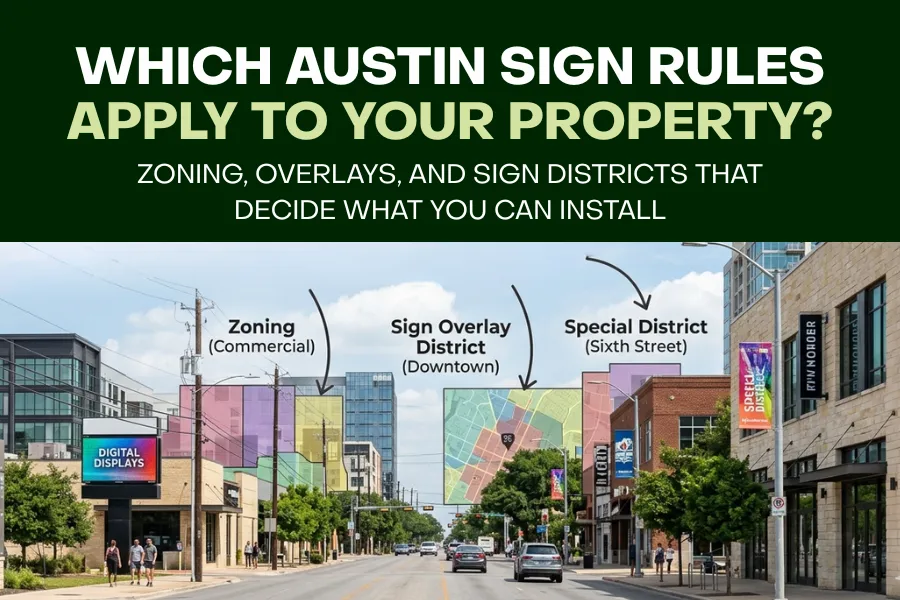
To figure out what you’re allowed to do, you typically need to:
- Look up your property in the Land Development Code / Code of Ordinances
- Determine your zoning and sign district (there’s a City tool just for that)
- Check if you’re in any special overlays or historic districts
- Match your sign type (wall, awning, freestanding, projecting, temporary, etc.) to the correct section of Chapter 25-10
That’s before you even talk about artwork, LED levels, or structural engineering.
This is why we tell clients:
The confusion is not a bug. It’s the moat. The more complex the rules, the more valuable it is to have someone on your team who lives in this world every day.
That’s us.
What the City Expects You to Submit (In Theory)
The City’s Sign Permits page and Sign Permit Application outline what’s required to even get your application reviewed:
Things like:
- A completed Sign Permit Application (one per sign)
- Construction drawings of the sign (often sealed by a licensed architect or engineer)
- A site plan to scale showing location, setbacks, frontage, easements, and existing signs
- Attachment details for wall/awning signs
Structural and footing details for freestanding or roof signs Electrical info if the sign is illuminated
Any missing or incorrect details?
Best case: delays.
Worst case: denial and redesign.
Common Mistakes That Get Austin Signs Red-Tagged
Even smart, experienced business owners in Austin make the same sign permit mistakes again and again. The patterns are predictable—and expensive. The most common are:
- Installing first, permitting later (or never), assuming “it’s just a sign.”
- Guessing on sign size, height, or location without checking the Austin sign code (Chapter 25-10) or the sign district.
- Reusing an old sign structure or cabinet without confirming it still complies with current code.
- Ignoring illumination limits and ending up with a sign that is “too bright” for its corridor or neighbors.
- Submitting incomplete drawings or missing details that trigger correction cycles and delays.
Each of these mistakes slows your project, increases your costs, and hands attention to your more prepared competitors. Avoiding them is part of how you turn the Austin sign code from a liability into a strategic marketing moat.
The Money Side: Fees, Reviews, and “Death by Line Item”
On top of design and fabrication, you’re dealing with:
- Sign review fees
- Sign permit fees that vary based on type, size, and location
- Possible outdoor advertising license fees if applicable
- Other Development Services fees listed in the City’s annual fee schedules
Miss something, pay late, or choose the wrong category, and you’re spending more money for more delay.
Again: this is not where you want to be “learning as you go.”
The Official Process (And Where We Step In)
-
Register as an Outdoor Advertising Contractor
You’re expected to register via the Outdoor Advertising Registration form, provide proof of insurance, and get set up through the City’s contractor registration system before you even submit sign permits.
Our role: We already know this flow. We help ensure the right party is registered correctly so your project doesn’t stall at step one.
-
Determine Your Sign District
You must use the Sign District Determination Tool to confirm the sign district for your property, which dictates what’s allowed. Overlays like scenic or historic can change the rules entirely.
Our role: We map your site, district, and use type before we even sketch a design—so we don’t propose something the City will reject on day one.
-
Submit an Application
You complete the Sign Permit Application, prepare drawings, and upload everything via the Austin Build + Connect (AB+C) Portal. Then you wait for staff review, comments, and possible corrections.
Our role: We build complete packets, respond to correction comments, and speak the City’s language so you don’t have to.
-
Pay Your Review Fee
Nothing moves until the review fee is paid. Late payment? Your file sits.
Our role: We track your permit status and keep the process moving so your sign isn’t stuck in bureaucratic limbo.
-
Permit Approval & Activation (Especially for Electrical Signs)
If the sign is illuminated, an electrical permit is auto-generated and must be handled by a registered electrical sign contractor. Non-illuminated signs may finalize upon approval; illuminated signs require additional steps and inspections.
Our role: We coordinate the structural permit and electrical permit paths so you don’t accidentally install something that fails inspection.
-
Electrical Sign Inspection
A “303 Electrical Sign” inspection is required for illuminated signs once installed, scheduled through AB+C.
Our role: We make sure your sign is built to pass the first time, not after costly rework.
-
Renewals & Extensions
Permits can expire. Modifications and extensions have their own request process through the City’s contractor services forms.
Our role: We help you stay compliant so your visibility doesn’t suddenly become a code violation a year later.
Why This Complexity Is Actually Good News (For You)
All of this might sound intimidating—and honestly, it is.
But that’s exactly why the Austin sign code can turn confusing rules into your marketing moat.
Most businesses:
- Put up non-compliant signs
- Cut corners on permits
- Or give up and live with tiny, weak signage
When you work with a team that understands both marketing and the City of Austin Land Development Code, you don’t just “get a sign.” You get a permitted, protected, long-term visibility asset that your competitors can’t easily copy or outflank.
Real-World Examples: When the Code Becomes a Moat
We’ve seen corridors where half the businesses are stuck with tiny, barely visible signs because they ran into Austin sign code problems early and gave up. Right next door, a competitor invested in a fully permitted, code‑optimized sign that dominates the sightline from the street. Same block, same rules—very different outcomes.
In another case, a client tried to install a large illuminated sign without understanding Austin’s sign district limits in Chapter 25‑10. Their first attempt drew a violation notice and a removal order. After we redesigned within the Austin sign code and secured the proper permits, they ended up with a sign that was not only compliant but far more visible than their original DIY concept. The difference wasn’t luck; it was using the Austin sign code as a strategic design constraint instead of an afterthought. If you want to see how this plays out visually across different industries, check out our signage examples in Austin to see what fully permitted, code‑smart signs look like in the real world.
Let Austin Sign Masters Be Your Code Translator
We’ve spent decades in Austin doing two things: helping businesses grow with high‑impact signage and branding, and navigating the City’s sign regulations, permits, and inspections so owners don’t have to lose their minds (or their money) over compliance.
As a trusted signage company in Austin, TX, we focus on turning the Austin sign code into a strategic advantage for your business instead of a constant headache.
You don’t need to read the code. You need a partner who already has.
Ready to Stop Guessing and Start Growing?
If you’re planning a new sign, upgrading an existing one, or worried your current sign may not be compliant:
- We’ll review your situation
- Flag potential code and permit issues
- Propose a compliant, high-ROI signage strategy for your business in Austin
No lectures. No jargon. Just clarity, options, and a path forward.
Get in touch with Austin Sign Masters today and let the Austin code work for you, not against you and see how our custom signs in Austin, TX can turn compliance into long‑term visibility.