
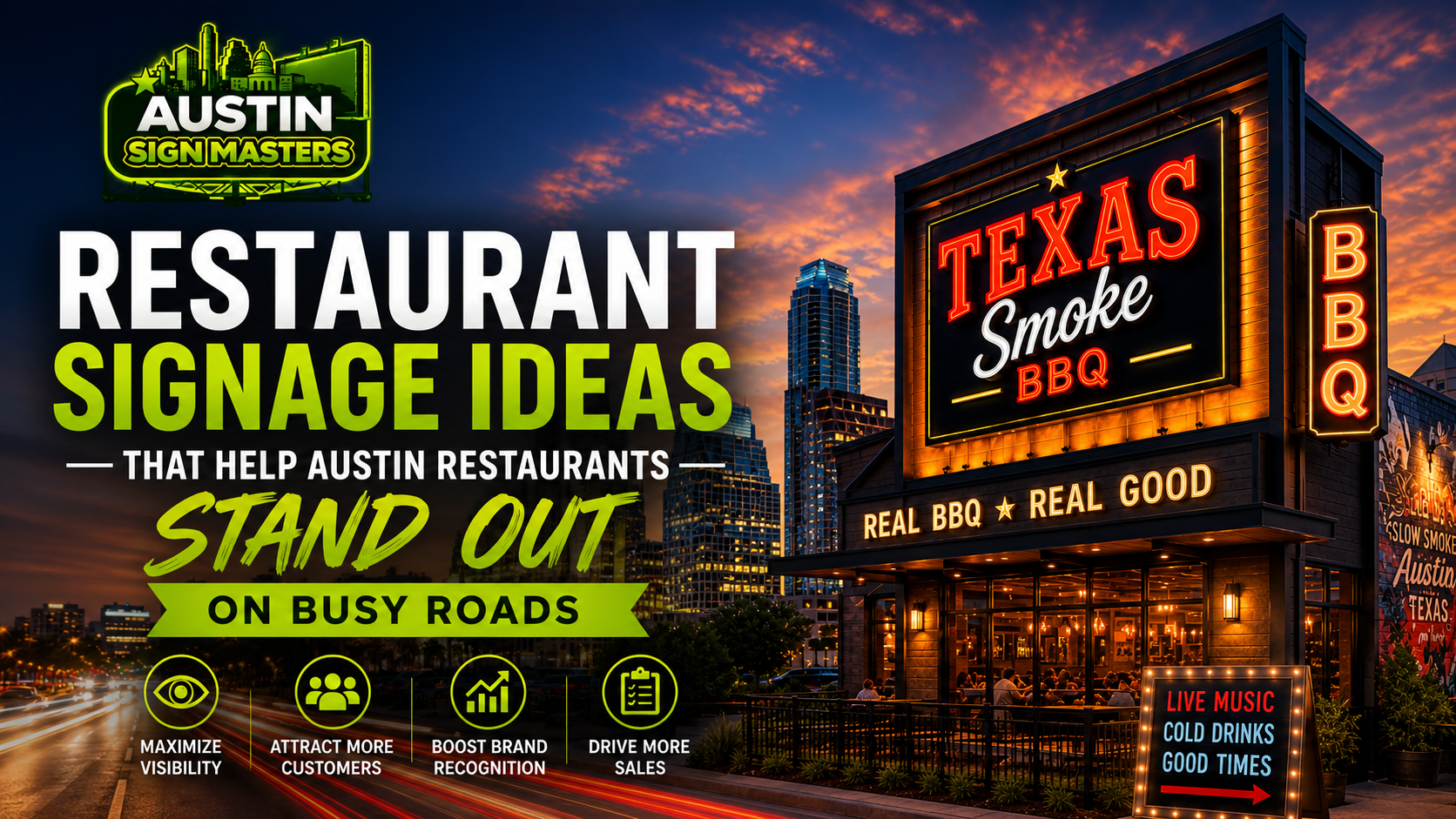
Restaurant signage Austin business owners choose can determine whether drivers notice a dining concept, remember its name, and make the turn before they pass the entrance. On roads such as South Congress Avenue, Burnet Road, Lamar Boulevard, Airport Boulevard, and Research Boulevard, a restaurant has only a few seconds to earn attention. The best signs make those seconds count.
This practical guide covers restaurant signage ideas that help Austin restaurants stand out on busy roads. It explains which sign types work, how to improve readability, what to consider before installation, and how to combine exterior and interior signs into a consistent customer experience.
Table of Contents
- Why restaurant signage matters on Austin roads
- 12 restaurant signage ideas for stronger visibility
- Design rules for readable roadside signs
- Austin permits, placement, and local conditions
- How to build a complete restaurant sign system
- Common restaurant signage mistakes
- Restaurant signage planning checklist
- Frequently asked questions
Why Restaurant Signage Matters on Austin Roads
When planning restaurant signage Austin owners should start with the actual customer approach. Austin is filled with restaurants competing for attention. Established barbecue spots, food halls, neighborhood cafes, drive-thrus, breweries, and new concepts often share the same commercial corridors. A driver moving with traffic is not carefully studying every storefront. Your sign must communicate quickly and clearly.
Effective restaurant signage Austin operators install does more than identify a building. It helps customers understand where to enter, what type of experience to expect, and whether a restaurant is open. It can also improve repeat visits by making the location easier to remember.
Catch attention before drivers pass your entrance.
Turn a location into a memorable landmark.
Help first-time guests know where to park and enter.
Support impulse visits and repeat business.
12 Restaurant Signage Ideas for Stronger Roadside Visibility
1. Illuminated Channel Letters
Channel letters are one of the most reliable choices for busy roads. Each letter is individually fabricated and illuminated, creating a polished look that remains visible after sunset. Front-lit letters work well for energetic concepts, while halo-lit letters offer a more refined appearance for upscale restaurants, wine bars, and modern cafes.
Use a short name, strong contrast, and a letter height that fits the viewing distance. A beautifully designed sign still fails if the letters are too small to read from moving traffic.
2. Blade Signs for Pedestrian and Side-Angle Traffic
A blade sign projects outward from the building rather than sitting flat against the facade. It can be highly effective for restaurants in walkable areas such as downtown, South Congress, East Austin, and mixed-use developments. Blade signs also help when approaching drivers see the side of a building before they see its front elevation.
3. Monument Signs Near Driveway Entrances
When a restaurant is set back from the road, located in a shopping center, or surrounded by landscaping, a monument sign can improve discovery. Place it where drivers need to make a decision. Include the restaurant name and keep the message simple. If the sign includes multiple tenants, reserve enough visual contrast so the restaurant listing remains easy to find.
4. Pylon Signs for High-Speed Corridors
Pylon signs are taller freestanding signs designed for distance. They are especially useful when a restaurant needs visibility from a larger road or highway-oriented commercial area. A pylon sign should not become a crowded menu board. A logo, restaurant name, and one concise descriptor are usually enough.
5. Window Graphics That Support the Main Sign
Window graphics can promote pickup, catering, happy hour, coffee, breakfast, or late-night service without competing with the primary sign. Use them selectively. Large areas of dense vinyl can make a storefront feel closed off. Frosted details, simple hours, and a few carefully placed graphics maintain a clean, welcoming appearance.
6. Digital Menu Boards for Fast Updates
Digital menu boards work well inside quick-service restaurants, food halls, and counter-service concepts. They simplify updates and help customers scan options while waiting. Outdoors, electronic message centers may be appropriate in some locations, but content should remain brief and legible. Avoid rapid animations that distract from the essential message.
7. Drive-Thru Directional Signs
Drive-thru guests need clear guidance before they reach the ordering point. Use consistent arrows and short instructions for entry, ordering, pickup, mobile orders, and exit lanes. Directional signs reduce confusion and prevent vehicles from blocking parking or pedestrian areas during peak service.
8. Patio and Sidewalk Signs
A-frame signs and patio signs can communicate daily specials, live music, brunch, or seasonal offers. They work best when treated as an extension of the brand. Use a consistent color palette and large lettering. Confirm that placement does not obstruct walkways or conflict with local requirements.
9. Dimensional Lobby Logos
Exterior visibility brings guests in. Interior branding completes the experience. A dimensional wall logo near the host stand or pickup area creates a professional focal point and an appealing photo backdrop. Restaurants frequently benefit when guests naturally include the brand in social photos.
10. Menu, Pickup, and Wayfinding Signs
Guests should immediately understand where to order, wait, pick up food, find restrooms, and exit. Small wayfinding signs remove friction. This is particularly important for restaurants offering dine-in, curbside pickup, delivery drivers, and catering from the same location.
11. Neon-Style Accent Signs
A neon-style statement sign can add personality without replacing the main identification sign. Use one memorable phrase tied to the concept or neighborhood. Place it where customers can photograph it, and make sure the color supports the broader brand rather than feeling like an unrelated decoration.
12. Temporary Signs for Grand Openings and Seasonal Promotions
Banners, window graphics, and temporary signs can support a restaurant opening, patio season, game-day promotion, or limited menu launch. Temporary does not need to look improvised. Match the permanent brand standards and plan removal dates before installation. For more ideas, read our guide to seasonal rebranding signage for Austin businesses.
Design Rules for Readable Restaurant Signage Austin Drivers Can Notice
Great restaurant signage Austin drivers can read is designed around speed and distance. The difference between a visible sign and an effective sign is readability. Roadside signs are experienced at speed, often during bright afternoon sun, rain, or nighttime traffic. Use the following principles during design review.
A site review keeps restaurant signage Austin decisions grounded in real viewing distance, traffic direction, and customer flow.
Prioritize one primary message
Your restaurant name should be the first thing people see. A short descriptor such as “BBQ,” “Tacos,” “Coffee,” or “Seafood” can help when the concept is not obvious. Long taglines, phone numbers, and multiple promotional messages dilute the impact.
Choose contrast before complexity
Dark letters on a light background or bright illuminated letters on a dark background are easier to read than similar colors placed together. Contrast is especially important when storefront materials, trees, parked vehicles, and neighboring signs create visual noise.
Use fonts that remain clear at a glance
A distinctive typeface can reinforce a restaurant brand, but overly thin strokes and elaborate scripts can disappear at distance. If the logo uses detailed lettering, pair it with a simpler supporting wordmark or descriptor.
Design for day and night
Evaluate how the sign will appear in direct sun, shade, dusk, and full darkness. Illumination should improve clarity without producing glare. Restaurants that serve dinner need signage that looks intentional after sunset, not merely signs that happen to remain visible.
Keep the whole property consistent
The main sign, entry signs, menus, parking signs, pickup signs, and patio messaging should feel like one system. Customers notice inconsistency even when they cannot identify the specific problem.
Austin Permits, Placement, and Local Conditions
Every restaurant signage Austin project should begin with a site-specific review. Before fabrication, confirm what is allowed at the specific address. Building type, zoning, sign area, illumination, placement, landlord standards, and historic district considerations may affect the final design. The City of Austin provides information about sign permits, and local requirements should be reviewed early in the process.
Restaurants should also consider practical site conditions:
- Traffic direction: Identify where most drivers first see the property.
- Viewing distance: Match letter size and sign scale to the road speed and setback.
- Sun exposure: Avoid materials and colors that become difficult to read in glare.
- Landscaping: Plan for trees and shrubs at mature height, not only installation day.
- Neighboring signs: Create distinction without adding clutter.
- Parking and entrances: Guide customers clearly from the road to the correct door.
For additional context on traffic safety and roadway planning, the Texas Department of Transportation provides statewide transportation resources. A sign company should review the actual site and coordinate the appropriate permitting path before manufacturing begins.
How to Build a Complete Restaurant Sign System
Successful restaurant signage Austin programs are planned as systems instead of individual signs. The strongest projects are planned as systems instead of individual signs. Start with the customer journey and list each point where a guest needs information.
A simple five-zone restaurant sign plan
- Roadside discovery: monument, pylon, or high-visibility facade sign.
- Building identification: channel letters, cabinet sign, or dimensional logo.
- Arrival: parking, curbside pickup, and entrance directions.
- Ordering: menu boards, queue instructions, and pickup markers.
- Experience: lobby logo, patio signs, wall graphics, and photo-friendly accents.
Planning the entire journey helps avoid piecemeal signage. It also makes budgeting clearer because the restaurant can identify what must be installed before opening and what can be added during a later phase.
Common Restaurant Signage Mistakes to Avoid
Trying to say too much
A roadside sign is not a printed menu. The more messages it contains, the less likely drivers are to absorb any of them. Focus on recognition first.
Choosing size based only on the storefront
A sign can look large when standing directly beneath it and still look tiny from the road. Review renderings from realistic viewpoints.
Ignoring the approach angle
Flat wall signage may be hard to see until a driver has already passed the entrance. A projecting sign, monument sign, or secondary identification sign may solve the problem.
Waiting until construction is nearly finished
Permitting, design approvals, fabrication, and installation require coordination. Start the conversation early, especially for a new restaurant opening.
Using disconnected temporary signage
Handwritten notices and mismatched banners can weaken a carefully designed storefront. Even short-term messages should follow the brand.
Restaurant Signage Planning Checklist
- Photograph the property from each traffic direction.
- Record road speed, setbacks, entrances, and sightline obstacles.
- Identify the primary sign and supporting directional signs.
- Confirm landlord guidelines and local permit requirements.
- Choose colors and materials that work during the day and at night.
- Review letter size from realistic viewing distances.
- Plan parking, pickup, drive-thru, and delivery-driver directions.
- Coordinate fabrication and installation with the opening schedule.
- Leave room for future seasonal promotions.
For owners comparing options, restaurant signage Austin planning works best when visibility and guest flow are considered together. The most effective restaurant signage Austin locations use is simple enough to read quickly and distinctive enough to remember later.
Frequently Asked Questions About Restaurant Signage Austin Businesses Use
What type of restaurant sign is best for a busy Austin road?
The best choice depends on the setback, traffic speed, building orientation, and surrounding signs. Illuminated channel letters are a strong starting point for many restaurants. Properties set back from the road may also need a monument or pylon sign.
How early should a restaurant start planning signage?
Start as early as possible during the build-out process. Design, approvals, permitting, fabrication, and installation all take time. Early planning also allows electrical needs and mounting conditions to be coordinated with contractors.
Should restaurant signs be illuminated?
Restaurants serving dinner or operating early in the morning usually benefit from illumination. The right lighting improves visibility and reinforces the intended atmosphere after dark.
Can a restaurant use temporary promotional signs?
Temporary signs can work for openings, seasonal menus, and events when they follow applicable rules and remain visually consistent with the permanent brand.
How can small restaurants improve visibility on a limited budget?
Prioritize the sign with the greatest roadside impact, then add clear entrance and pickup directions. Window graphics and professionally designed temporary promotions can support the main sign without overwhelming the storefront.
Make Your Restaurant Easier to Notice
A well-planned restaurant sign system helps customers find you, remember you, and return. Austin Sign Masters can help evaluate visibility, select sign types, and create a cohesive look for your property.